Chapter 07 · Sector information → shared record · Work in progress
Intelligentsia — Sector source of truth
A single structured base for one niche — sources, entities, and market facts in one place — so judgment starts from a shared record instead of scattered tabs.
Why I built it
In any specialised sector, the same facts live in PDFs, registries, decks, and half-updated sheets. People waste judgment reconciling sources before they can decide.
I wanted one shared record for a niche: what is known, where it came from, and how entities relate — a source of truth you can challenge, not another feed to skim. Voluntary carbon markets are the first niche the MVP uses to prove the shape.
Overview
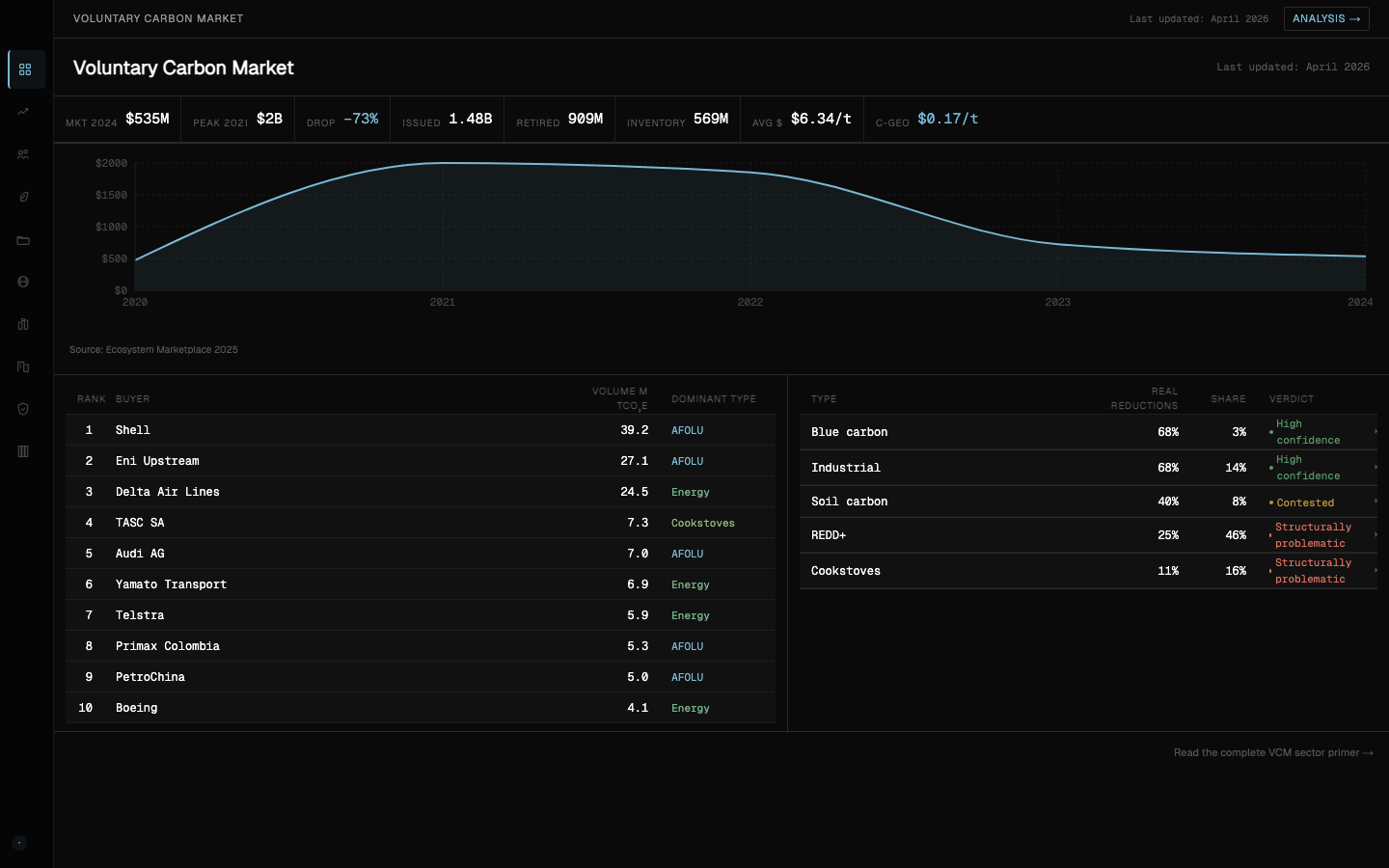
Intelligentsia is a sector intelligence surface: a dashboard over structured market data, entity pages (players, projects, buyers, countries), a source library, and an analysis layer on top.
The product idea is portable — pick a niche, ingest and normalise what matters, and keep one base everyone can inspect. The current MVP is local only; there is no public try URL yet.
Dashboard
Opens the niche with the headline numbers and the short path into market, entities, and sources.
This is the front door to the shared record — not a newsletter, not a dump of every table.
Without a single entry view, a sector database feels like a warehouse. The dashboard is where the claim of a source of truth has to feel usable on first open.
Market
Holds the quantitative spine of the niche — size, prices, issuance and related series — as structured data you can return to.
Use it when the question is “what does the record say about the market?” before you open a single project or buyer.
A source of truth that skips the market layer leaves every conversation starting from someone’s favourite chart.
Sources
The library of inputs behind the structured tables — so a number or claim can be traced back to where it came from.
This is how trust attaches to the record instead of to memory.
Without sources, a sector database is just another confident spreadsheet. Provenance is part of the product.
Players
Entity views for the organisations and actors that structure the niche — linked into projects, buyers, and other tables in the same base.
You move from a name to its place in the record without leaving the system.
Sectors are networks of actors. If entities live only in prose, the source of truth cannot answer “who is this, and what else do we hold on them?”
Projects
Project-level records for the niche — the concrete units the market and actors attach to — with paths into types, countries, and related entities.
This is where the shared base becomes specific enough to argue about a single case.
Abstract market stats without project grain stay unchallengeable. Projects are where the record meets the real world.
Analysis
A deeper cut on top of the same data — written and interactive analysis that stays tied to the structured base rather than floating as a separate deck.
WIP: the layer exists in the MVP; public packaging and polish are still open.
A source of truth that never supports analysis is only a filing cabinet. Analysis is how the record earns its keep for decisions.
How I built it
Next.js intelligence UI over a Postgres-shaped schema and collection pipelines for the first niche (voluntary carbon markets). Entity routes for market, players, projects, countries, buyers, regulatory, and sources; an analysis surface on the same stack.
Hard choices: schema-first so every view reads from one base; niche-specific pipelines without hard-coding the product idea to carbon; keeping the UI honest while the corpus is still incomplete.
What I got wrong, and what’s next
The MVP proves the shape locally. It is not public yet on purpose — seed quality, first-run clarity, and a portable niche switch still need work before a stranger should land on it cold.
Next: tighten the source-of-truth story in the UI itself, capture stable screenshots as the local build settles, then decide when a private or public demo host is worth it.